
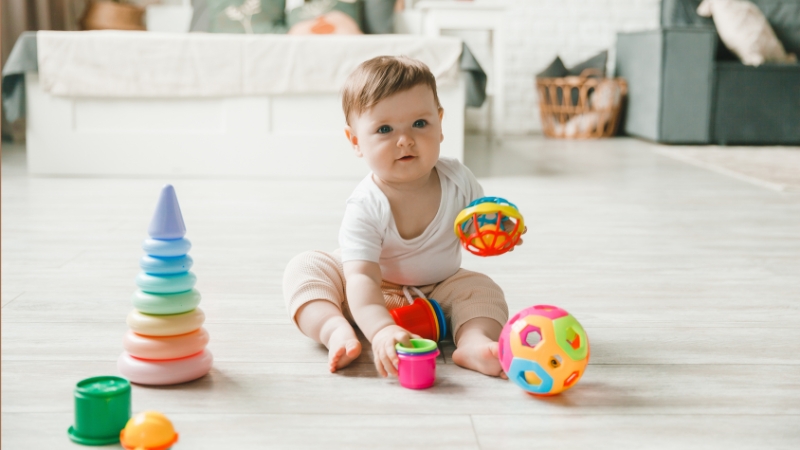
At 6 months, most babies are no longer just reacting to the world. They are starting to control their bodies better, use movement on purpose, and show clearer signs of curiosity, recognition, and early problem-solving.
In practical terms, this often looks like rolling in at least one direction, pushing up with straight arms during tummy time, reaching for toys with intent, bringing objects to the mouth to explore them, noticing familiar people, and responding more actively to sounds, faces, and routines.
The important point that CDC notes is not that every baby does every skill in the same way on the day they turn 6 months old. It is that you should see a real pattern of progress in both movement and thinking.
Motor Milestones at 6 Months
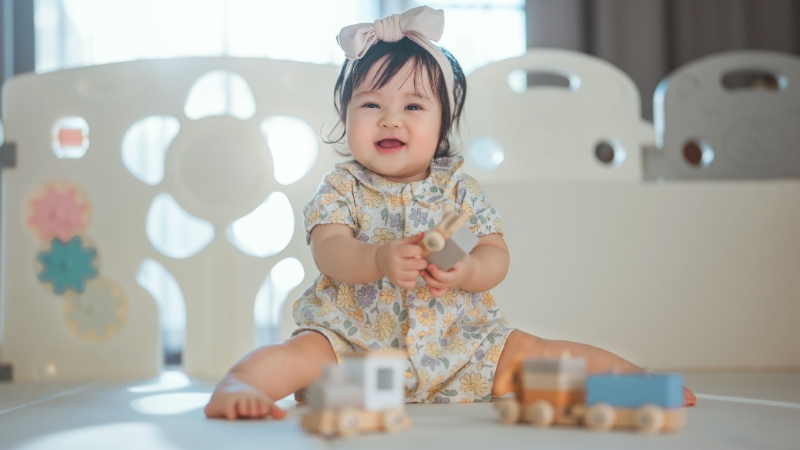
Motor development at this age is about control, strength, balance, and purposeful movement. Many babies can roll from tummy to back, and some can roll both ways. During tummy time, many can push up on straight arms and lift the chest well off the floor. Their head control should be much steadier than it was a few months earlier.
When held in a sitting position, they usually look more stable, even if they still need support. Some can sit briefly with help or prop sit with their hands, though fully independent sitting is not expected in every baby right at 6 months.
The World Health Organization’s motor development windows show that normal timing for major gross motor skills varies, and independent sitting commonly emerges across a range rather than on one fixed date.
Another big change is that movement becomes intentional. A 6-month-old is not just waving arms randomly.
They often reach directly for a toy, grab it, transfer attention between objects, and try again if they miss. Legs also become more active. Many babies kick strongly, push against surfaces, and bounce when supported upright. These actions are not just cute moments.
They show increasing muscle strength, postural control, and sensory coordination. Developmental research describes infant motor progress as a product of growing strength, practice, balance, and everyday experience, not as a single switch that turns on all at once.
Concrete Motor Signs You May Notice
A 6-month-old may:
Not every baby will do all of these in the same week. What matters more is that the baby is clearly more organized and stronger in movement than at 4 months.
Cognitive Milestones at 6 Months
Cognitive Skill Area
What It Can Look Like at 6 Months
Everyday Example
Exploration
Baby studies objects with hands and mouth
Grabs a toy, turns it, chews it, drops it
Attention
Focuses longer on a person, sound, or object
Watches a parent talk or stares at a moving toy
Recognition
Reacts differently to familiar people
Smiles faster at a parent than at a stranger
Early cause and effect
Repeats actions that create a result
Shakes a toy again after hearing the sound
Anticipation
Starts to expect familiar routines
Gets excited when seeing a bottle or bib
Social response
Shows more back-and-forth engagement
Laughs, squeals, or waits for a reaction during play
Preference
Makes simple choices or shows likes and dislikes
Reaches for one toy more than another
Sensory learning
Uses touch, sound, and taste to learn
Rubs fabric, bangs objects, mouths teething toys
At 6 months, cognitive development is still basic, but it is very active. Babies this age learn through repetition, touch, sound, movement, and face-to-face interaction.
One of the clearest cognitive signs is exploration. A baby reaches for an object, grabs it, turns it, mouths it, drops it, and tries again. That is early learning in action.
The CDC lists reaching for a wanted toy and putting things in the mouth to explore them among the expected cognitive milestones at this age. This is not random behavior. It is how babies gather information about texture, shape, temperature, resistance, and cause and effect.
Recognition also becomes more obvious. Many babies know familiar faces, show more interest in caregivers than strangers, and react differently depending on who is holding them or talking to them.

They may pause when hearing a familiar voice, smile before being touched, or become more animated when a parent enters the room.
Mirror interest is another classic sign. A baby may look at a reflection with obvious attention, sometimes smiling or vocalizing. These behaviors show that memory, attention, and social awareness are becoming more organized.
At this age, babies also begin to show early signs of preference and decision-making. One example is closing the lips to signal they do not want more food.
That may sound simple, but it reflects sensory processing, response control, and communication. In everyday life, 6-month-olds also start to anticipate routines.
They may get excited when they see a bottle or spoon, calm when they hear a familiar bedtime pattern, or react before a favorite game like peek-a-boo fully starts. These are small but meaningful signs that the brain is not only receiving information, but organizing and predicting it.
How Motor and Cognitive Skills Work Together
View this post on Instagram
Parents often separate movement from learning, but babies do not. When a baby rolls, reaches, props up, or bats at a toy, that movement creates new chances to learn. They see objects from a new angle.
They notice distance. They discover that effort changes results. A baby who can reach for a toy starts practicing attention, goal direction, and trial and error at the same time.
This is why developmental specialists often talk about cascading effects. One area improves, and that improvement opens the door for progress in another area.
A 2020 study found that 6-month gross motor skills were related to 12-month motor and cognitive outcomes, reinforcing the idea that early physical skills matter for broader development.
This does not mean an early roller is automatically “ahead” in every way or that a slightly later baby is in trouble. It means development is connected.
A baby who gets more chances to move, explore, and interact usually gets more chances to learn. That is also why daily routines matter so much more than expensive toys.
What Is Normal Variation and What Is Not

Normal variation is wide in infancy. Some babies roll early and sit later. Some are very verbal and social before they are physically bold. Some are cautious movers but intense observers.
The WHO motor data were designed partly to show that milestone timing naturally varies across healthy children. That helps prevent parents from treating one exact age as a hard deadline for every skill.
What matters more than comparison is trajectory. Ask practical questions. Is the baby gaining control month by month? Is there more strength than before?
More interaction. More purpose. More alertness. More response to people and objects. If the answer is yes, that is usually reassuring.
Concern rises when there is very little change, loss of skills, marked stiffness or floppiness, very poor head control by this age, limited response to sound or faces, or no real effort to reach and engage with the environment.
Signs That Deserve a Pediatric Discussion
Parents should bring it up if a 6-month-old is not showing progress in the basic areas expected for this stage.
That can include seeming very floppy or very stiff, having poor head control, not rolling in either direction by the later part of this window, not reaching for objects, not bringing objects to the mouth, not laughing or making interactive sounds, or seeming unusually disengaged from people.
The American Academy of Pediatrics advises developmental surveillance at every well visit and formal developmental screening at key ages, with extra screening whenever a parent or clinician has concerns.
A practical rule is simple. If you are watching your baby and consistently thinking, “something feels off,” that is enough reason to raise it. You do not need to wait for a dramatic delay. Early evaluation does not label a child. It gives you better information and, when needed, earlier support.
How to Support Motor Development at 6 Months

The most useful support is usually simple and repetitive. Daily tummy time still matters at 6 months because it builds shoulder strength, trunk control, and the foundation for rolling, pivoting, and later mobility.
Floor time matters more than time spent contained in swings, loungers, or seats. Babies need room to practice turning, reaching, pushing, and shifting weight.
Place a toy slightly to one side rather than directly in front of the baby. That encourages rotation and reaching. Let the baby spend time on a firm, safe surface.
Change positions during wake time. Carry the baby in ways that allow them to look around. Give them objects with different textures and easy-to-hold shapes. These ordinary experiences create hundreds of small practice opportunities across a week.
How to Support Cognitive Development at 6 Months
Talk during routine care. Pause after making a sound and let the baby respond. Repeat simple games. Use songs with a predictable rhythm.
Offer one object at a time so the baby can focus. Let them explore safe household items with different textures, sounds, and weights.
Read short board books even if the baby does not follow the story. At this age, the value is in voice, rhythm, repetition, eye contact, and shared attention.
The strongest cognitive input is still human interaction. A baby learns more from a responsive adult face than from most gadgets.
When you mirror sounds, name what the baby is looking at, and respond to their attempts to communicate, you are building attention, early language, social understanding, and memory all at once.
Bottom Line
@charlottes_life47 What are some 6 month milestone to look forward to according to the NHS Also a reminder that all babies develop at a different pace! #baby6month #6monthsmilestone #babymilestones #motherhood #mumsoftiktok ♬ Cherry – Jordan Susanto
A healthy 6-month-old usually looks more deliberate than a younger infant. Movement is less random. Attention lasts longer.
Curiosity is easier to see. The baby is starting to act on the world, not just react to it. In motor terms, that means more control, more pushing, more rolling, more reaching.
In cognitive terms, it means more noticing, more exploring, more recognition, and more back and forth with people.