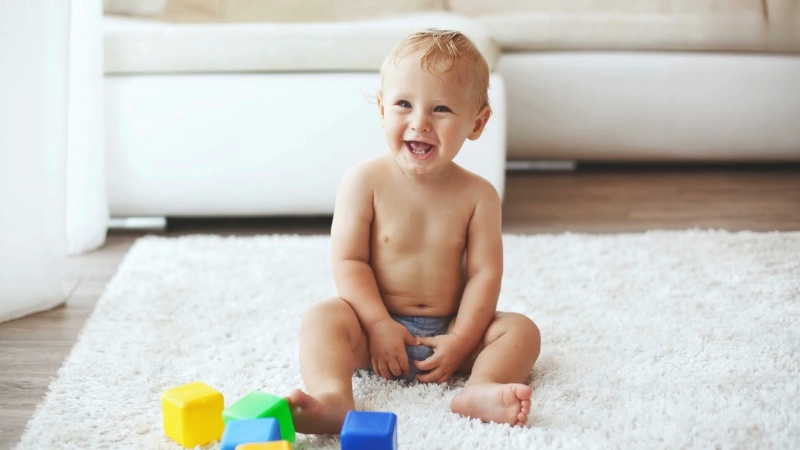
By 12 months, a baby is usually no longer in the early infant stage, where development is mostly about basic head control, watching faces, and simple reaching.
At this age, most children are becoming much more active, more intentional, and far more aware of people, objects, and routines around them.
In real life, that often means pulling up to stand, cruising along furniture, picking up small items with thumb and finger, following simple directions, looking for hidden objects, using simple gestures like waving, and making more purposeful sounds or early words.
The main thing to look for is not perfection in every single skill on the exact birthday.
It is whether you can clearly see progress in movement, communication, thinking, and social interaction over the past few months.
What 12 Months Usually Look Like
Development Area
What Many 12-Month-Olds Often Do
What It Looks Like in Daily Life
Why It Matters
Gross Motor
Pull to stand, cruise along furniture, stand briefly, sometimes take steps
Moves across the room with a goal, reaches higher surfaces, and explores more independently
Shows better balance, strength, and postural control
Fine Motor
Use pincer grasp, pick up small objects, and release toys on purpose
Picks up crumbs, drops blocks into containers, hands objects to adults
Reflects better coordination and hand control
Cognitive
Look for hidden objects, repeat actions for a result, and explore objects in different ways
Drops toys to watch what happens, opens containers, tests buttons, and sounds
Shows memory, curiosity, and early problem-solving
Language and Communication
Respond to name, understand simple phrases, babble with variety, and use gestures
Waves, points, lifts arms to be picked up, reacts to familiar words
Shows growing understanding and intentional communication
Social and Emotional
Prefer familiar people, imitate actions, seek reassurance from parents
Copies clapping, checks parent reaction in new settings, enjoys back-and-forth games
Reflects attachment, social learning, and early emotional awareness
A 12-month-old is often in a transition period between baby and toddler. Movement becomes more practical. Curiosity becomes more obvious.
Communication becomes easier to notice. Instead of only reacting, a child this age often starts to act with a goal in mind.
They may crawl or move toward a specific object, hand you something to get help, search for a dropped toy, copy a gesture, or repeat an action because they know it causes a response.
That shift matters because development at 12 months is less about isolated milestones and more about how different skills begin to work together.
Research on early development shows that motor, language, and social milestones are linked rather than separate tracks.
Gross Motor Checklist at 12 Months

At 12 months, many babies can pull up to stand and walk while holding onto furniture. Some can stand alone for a few seconds.
Some take independent steps. Others are not walking alone yet but are clearly close, especially if they cruise well, lower themselves with more control, and move confidently between support surfaces.
The World Health Organization data are useful here because they show that independent walking has a wide normal window. A child does not need to be fully walking alone exactly at 12 months to be developing normally.
Head and trunk control should usually look solid by this age. A child sitting on the floor often turns, reaches, shifts weight, and recovers balance more smoothly than before. Floor movement also becomes more efficient.
Some babies crawl on hands and knees, some bottom shuffle, some move by a mixed pattern, and some focus heavily on standing and cruising.
There is variation, but what should usually be present is purposeful movement from place to place and a clear ability to explore the environment with more independence than a younger infant.
Practical Motor Signs Parents Often Notice
A 12-month-old may:
Not every child will do all of those in the same week. What matters more is whether movement is becoming stronger, more coordinated, and more intentional.
Fine Motor Checklist at 12 Months
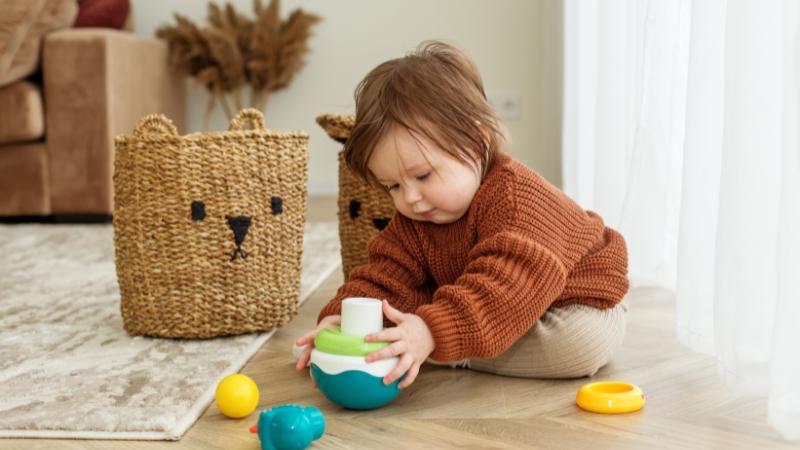
Fine motor development becomes much easier to spot around the first birthday. Many children can pick up small objects using a pincer grasp, meaning the thumb and index finger work together more precisely.
They often release objects on purpose rather than only dropping them. They may put blocks into a container, take them out again, bang two objects together, or hand objects to an adult. These are small actions, but they reflect real progress in coordination, control, planning, and attention.
You may also notice that hand use becomes more efficient in daily routines. A child may try to grab a spoon, finger feed, turn pages in a thick board book, or point with one finger.
That point is important. Pointing is not just a hand skill. It is part of communication and shared attention.
Developmental research from NCBI has treated pointing, walking, and early talking as major milestones because they reflect a broader jump in how children interact with the world and with other people.
Cognitive Checklist at 12 Months
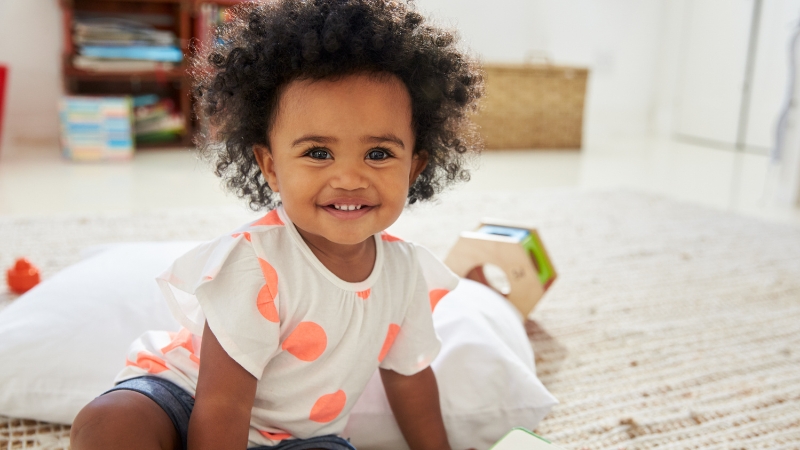
Cognitive development at 12 months is usually visible through problem-solving, memory, curiosity, and cause and effect.
Many children look for an object they saw you hide. They repeat actions that get a result, like pushing a button to hear a sound or dropping something repeatedly to watch what happens next.
They also start using objects in more deliberate ways, even if play is still basic. A child might shake a rattle differently than they handle a book or try to fit something into a container opening. These are early signs that the brain is sorting objects, actions, and outcomes with more structure.
At this age, attention is still short, but it is more organised than it was at 6 months. A 12-month-old often focuses on one task for longer, especially if it involves movement, sound, or social interaction.
They may anticipate familiar routines, know where certain objects usually are, and react when they hear words tied to daily life.
Infancy research also suggests that by around 12 months, children are already linking words to categories and beginning to use language as part of how they organise what they see.
Language and Communication Checklist at 12 Months
By the first birthday, many children respond to their name consistently, understand simple phrases, and follow very basic directions such as “come here” or “give it to me,” especially when paired with a gesture. A child may also wave bye-bye, lift arms to be picked up, clap, or point to request or show interest.
These gestures matter because they are part of communication, not just cute tricks. They show the child is learning how to get another person’s attention on purpose.
In speech, many 12-month-olds say “mama,” “dada,” or another simple word with meaning, though the exact number of words varies.
Some children are more gesture-heavy first and then add words. Others attempt more sounds before clear words show up. The bigger question is whether communication is moving forward.
A child should usually be babbling with variety, reacting to voices, and showing interest in two-way interaction. The combination of sound, gesture, eye contact, and response is more informative than counting words alone.
Social and Emotional Checklist at 12 Months
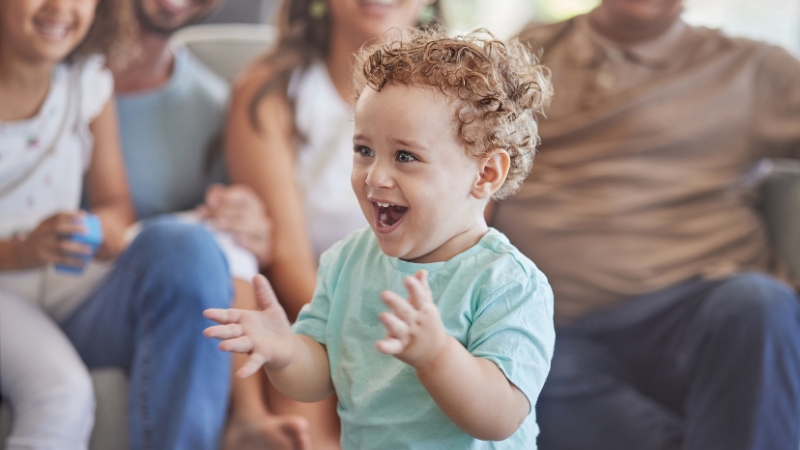
A 12-month-old usually shows much clearer preferences than a younger baby. Familiar people often get a different response than strangers. Many children look to a parent for reassurance in new settings.
They may hand over toys, imitate simple actions, or enjoy repetitive social games. Separation anxiety is also common around this age, and that is not automatically a problem. In many cases, it reflects stronger attachment and better awareness of who is familiar and who is not.
Imitation is especially important at this stage. A child may copy clapping, waving, tapping, or simple play routines.
Copying is a real developmental marker because it shows attention, memory, social learning, and motor planning all working together. When parents say, “He copies everything now,” that often describes an important shift in 12-month development.
How the Skills Connect at This Age
Twelve-month development is easiest to understand when you stop separating physical skills from mental skills.
When a child learns to stand and cruise, they can reach new objects, start new problems, and make more choices.
When they point, they are using a motor act to communicate a thought. When they follow a simple instruction, they are combining hearing, memory, attention, and action.
That is why early development is best viewed as a connected system. Studies looking at infant milestone timing have found that delays or slower progress across motor and language domains can relate to later neurodevelopmental outcomes, even though the size of those associations is usually modest, and individual variation remains wide.
What Is Normal Variation at 12 Months
View this post on Instagram
There is still a broad range of normal at 12 months. One child may be close to walking but say no words yet.
Another may point, imitate, and understand a lot of language, but still prefer crawling. Another may be physically advanced and socially cautious.
That is why milestone checklists are helpful only when they are used as guides rather than as rigid scorecards.
The most useful question is not whether the child matches another child. It is whether there is clear developmental movement over time.
Signs That Deserve a Pediatric Discussion
It is worth talking to a pediatrician if a 12 month old is not crawling or otherwise moving around purposefully, cannot pull to stand, seems very floppy or very stiff, does not use gestures like waving or pointing, does not respond to name consistently, shows very limited babbling or sound variety, does not look for hidden objects, or seems unusually disconnected from people.
It is also important to bring up any loss of skills.
Losing a skill is more concerning than simply being late to a milestone. The CDC milestone materials are designed to help parents notice patterns that deserve follow-up, and the AAP recommends ongoing developmental surveillance plus standardised screening at key ages.
Bottom Line
@charlottes_life47 These are some physical and communication 12 month milestones according to the NHS! All babies grow and are completely different 🌸 #12monthsold #babymilestone #babymilestones #motherhood #mumsoftiktok ♬ Stylish and cool BGM for VLOG(1528668) – Mrs.Simpson.
The most useful support at this age is not complicated. Give the child safe floor space, sturdy furniture for cruising, objects to put in and take out, blocks to bang together, and daily chances to practice moving. Talk during routines.
Name familiar objects. Read simple books with clear pictures. Play turn-taking games. Pause and let the child respond.
Follow their attention instead of constantly redirecting it. These ordinary routines give practice in movement, memory, language, and social interaction at the same time.
It also helps to keep expectations realistic. A 12-month-old does not need structured lessons. They need repetition, interaction, and room to try things.
The best signs of healthy development at this age are often simple ones: the child wants to move, wants to explore, wants to communicate, and wants a response from you.