
Educational support plans exist to ensure that students with disabilities receive appropriate assistance in school settings. Laws require public schools to provide support so that students can access learning opportunities and make academic progress.
Without structured plans, many students would face barriers that limit participation in general education environments.
- Individualized Education Program (IEP)
- the 504 Plan
While both support students with disabilities, IEPs and 504 Plans differ in purpose, eligibility requirements, types of services provided, and legal frameworks that govern their implementation.
Key Differences Between IEP and 504 Plan
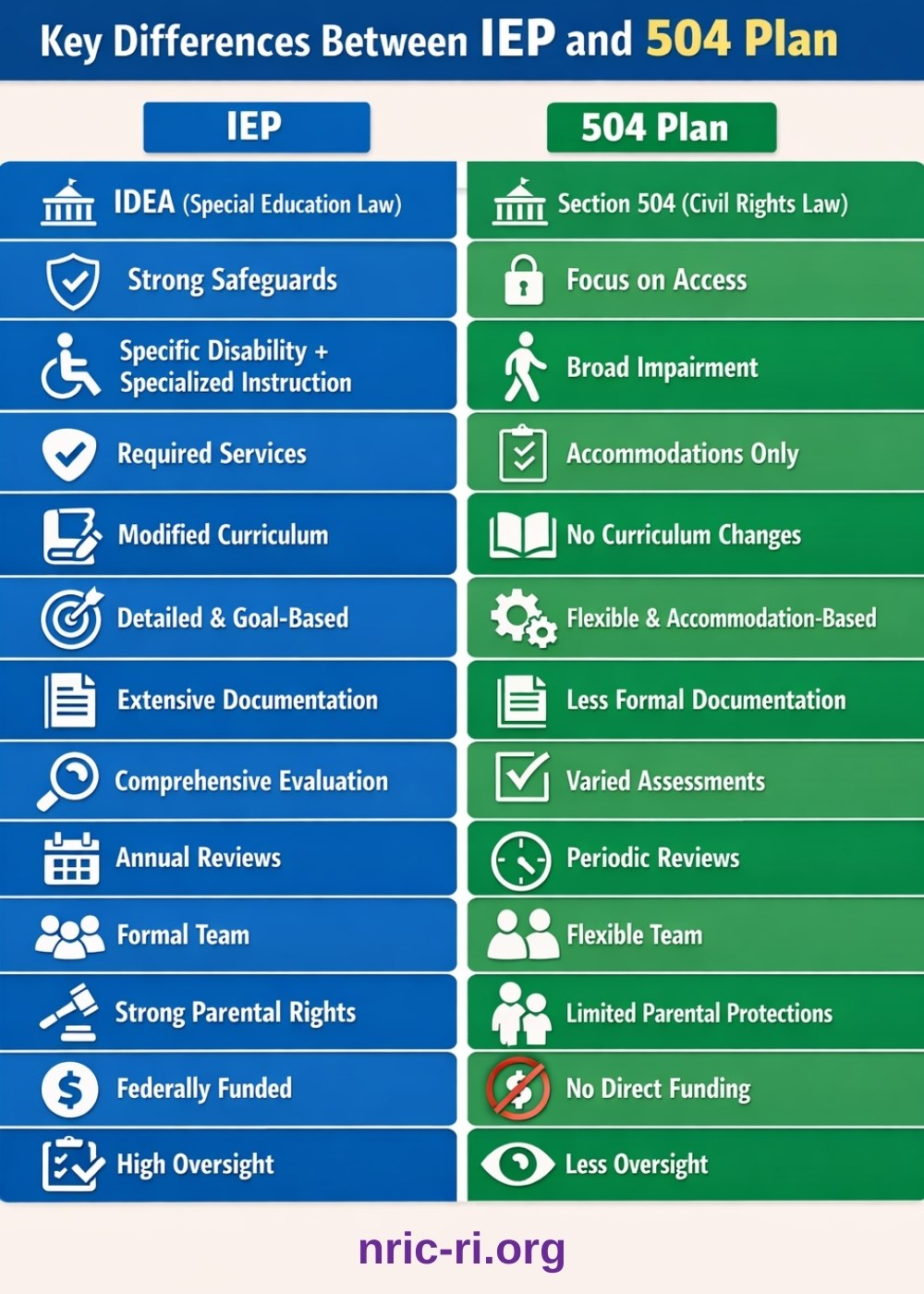
| Category | IEP | 504 Plan |
|---|---|---|
| Legal Framework | IDEA (special education law, federally funded) | Section 504 (civil rights law) |
| Legal Protections | Strong safeguards and formal procedures | Fewer safeguards, focus on access |
| Eligibility | Specific disability category + need for specialized instruction | Broad impairment limiting major life activity |
| Instruction Need | Required | Not required |
| Support Type | Specialized instruction, services, accommodations, modifications | Accommodations only |
| Curriculum Impact | May modify content and instruction | No change to curriculum |
| Structure | Detailed, goal-based, highly structured | Flexible, accommodation-based |
| Documentation | Extensive and ongoing | Less formal |
| Evaluation | Comprehensive, multi-area assessment | Flexible, varied methods |
| Review Timeline | Annual review, reevaluation every 3 years | Periodic review |
| Team | Formal team with required members | Flexible team |
| Parental Rights | Strong rights and due process | Fewer formal protections |
| Funding | Federally funded | No direct funding |
| Accountability | High oversight and compliance | Less oversight |
Clear distinctions between IEPs and 504 Plans shape how schools identify, support, and monitor students with disabilities. Differences affect eligibility, services, and legal responsibilities, which makes it important to examine each category in detail.
Legal Framework
Federal law defines how each plan operates and what schools must provide. IEPs are grounded in special education law, while 504 Plans focus on civil rights protections.
IEPs fall under the Individuals with Disabilities Education Act (IDEA), a federal law that provides funding and requires strict compliance. IDEA establishes detailed rules for identifying students, conducting evaluations, and delivering services. Schools must follow specific timelines and documentation requirements to remain compliant.
504 Plans fall under Section 504 of the Rehabilitation Act. Civil rights protections under Section 504 ensure that students with disabilities receive equal access to education. Requirements exist, though they are less detailed compared to IDEA.
- IDEA requires formal documentation of services, progress monitoring, and measurable goals
- Section 504 requires access and nondiscrimination but allows more flexibility in implementation
- IDEA includes due process procedures and formal dispute resolution systems
- Section 504 offers protections but with fewer structured enforcement steps
IDEA creates a more structured system with stronger procedural protections. Section 504 focuses on removing barriers that limit access to education.
Eligibility Criteria

Eligibility determines which students receive services and what type of support they will access. Criteria for IEPs are more specific, while 504 Plans allow broader inclusion.
IEPs require qualification under one of 13 disability categories, such as autism or specific learning disability. In addition, students must demonstrate a need for specialized instruction to make progress in school. Both diagnosis and educational impact must be clearly established.
504 Plans use broader eligibility standards. Any physical or mental impairment that substantially limits a major life activity may qualify a student. Major life activities include learning, attention, and mobility.
- IEP eligibility depends on both disability category and need for specialized instruction
- 504 eligibility focuses on functional limitation in daily or academic activities
- Students with mild or moderate challenges may qualify for a 504 Plan but not an IEP
- Academic performance alone does not determine eligibility for either plan
Eligibility for a 504 Plan centers on access. Students who can participate in general education with accommodations may qualify even without specialized instruction.
Type and Scope of Support
Nature of support provided through each plan reflects their different purposes. IEPs deliver instruction and services, while 504 Plans focus on access.
IEPs provide specialized instruction tailored to individual needs. Related services may include speech therapy, occupational therapy, or counseling. Plans often include curriculum modifications and individualized goals that guide instruction.
504 Plans provide accommodations that remove barriers in the general education setting. Supports help students access instruction without altering academic expectations.
- IEPs: specialized instruction, therapy services, modified assignments, individualized goals
- 504 Plans: extended time, seating adjustments, assistive technology, behavioral supports
- IEPs may change content or expectations based on student needs
- 504 Plans maintain standard curriculum while adjusting access conditions
Support within an IEP may alter what a student learns or how material is presented. Support within a 504 Plan ensures that students can access the same content as peers.
Individualization and Structure

Structure and level of detail differ significantly between the two plans. IEPs follow a formal format, while 504 Plans allow more flexibility.
IEPs require a highly structured document that includes measurable annual goals, service descriptions, and progress monitoring. Each element must align with IDEA requirements. Schools must track progress and report results regularly.
504 Plans are less formal. Documents typically outline accommodations without detailed goal tracking or standardized formats. Content may vary depending on district policies.
IEPs demand consistent documentation and accountability. 504 Plans allow adjustments with fewer formal requirements.
Evaluation and Review Process
Evaluation processes determine eligibility and guide support decisions. Requirements for IEPs are more comprehensive and strictly regulated.
IEPs require a full evaluation that assesses multiple areas, including academic performance, cognitive functioning, and social or behavioral needs. Schools must use a variety of assessment tools to gather accurate data.
Annual reviews are mandatory for IEPs, and reevaluations must occur at least every three years. These timelines ensure that services remain appropriate and effective.
504 Plans involve a less standardized evaluation process. Schools may rely on existing records, teacher observations, and informal assessments. Review schedules vary and are not as strictly defined.
- IEPs require comprehensive, multi-area evaluations
- 504 Plans allow more flexibility in assessment methods
- IEPs mandate annual reviews and triennial reevaluations
- 504 Plans are reviewed periodically based on school practices
IEP procedures create consistent oversight. 504 processes depend more on local decision-making.
Team and Parental Rights

Collaboration plays an important role in both plans, though structure and legal protections differ.
IEPs require a formal team that includes parents, general education teachers, special education teachers, and relevant specialists. Parents hold significant legal rights, including consent for evaluations and services. Dispute resolution options are clearly defined under IDEA.
504 Plans involve a team as well, though membership is more flexible. Schools may include staff members familiar with the student, and parents are invited to participate.
Parental involvement remains essential in both processes, though IDEA offers more detailed protections.
Funding and Accountability
Funding and oversight influence how services are delivered and monitored. IEPs receive direct federal support, while 504 Plans do not.
IEPs receive funding through IDEA. Schools must document how services are provided and demonstrate compliance with federal requirements. Accountability systems require detailed records and progress tracking.
504 Plans do not receive additional federal funding tied to services. Schools must still comply with civil rights laws, though oversight is less detailed.
Higher levels of accountability are associated with IEPs due to funding and legal requirements.
Similarities Between IEP and 504 Plan

Despite clear differences, both plans share several important features that support students with disabilities.
Both plans aim to provide access to education in public schools. Students receive support that allows participation in classroom activities alongside peers.
- Access to a Free Appropriate Public Education (FAPE) at no cost to families
- Use of accommodations such as assistive technology or classroom supports
- Requirement for schools to evaluate students suspected of having disabilities
- Collaboration between families and school staff during planning and implementation
- Legal obligation for schools to follow the plan once it is developed
Common goals focus on ensuring that students receive appropriate support and equal access to learning opportunities.
How to Determine Which Plan Is Appropriate
Selecting the right plan requires careful evaluation of a student’s needs and the level of support required. Decision-making involves reviewing data, academic performance, and functional challenges.
Need for specialized instruction is often the deciding factor. Students who require targeted teaching strategies or a modified curriculum typically qualify for an IEP.
Students who can succeed in general education with accommodations may be better suited for a 504 Plan. Support focuses on access rather than instruction.
Students may transition between plans as needs change. Progress or new challenges can lead to adjustments in support.
Parent advocacy plays a critical role in the process. Knowledge of legal rights and active participation help ensure that students receive appropriate services.
The Bottom Line
Major distinctions exist in eligibility, services, and legal protections between IEPs and 504 Plans. Each plan follows a different framework and addresses different levels of need.
Both plans remain essential tools for educational equity. Students with disabilities benefit when schools provide appropriate support tailored to individual needs.
Informed decision-making and active collaboration between parents and schools help ensure that students receive the support necessary for success.