
Literacy involves two closely connected processes: reading and writing. Reading relies on decoding, while writing relies on encoding. Both depend on shared knowledge of sounds and symbols within a language system.
Development of strong literacy skills requires growth in both areas at the same time. Skilled readers and writers build decoding and encoding together, not as isolated abilities.
Recognition of this relationship plays a key role in effective instruction. Teaching approaches that connect reading and writing support stronger outcomes in both areas.
Let’s talk about these two in greater detail.
Key Differences Between Decoding and Encoding
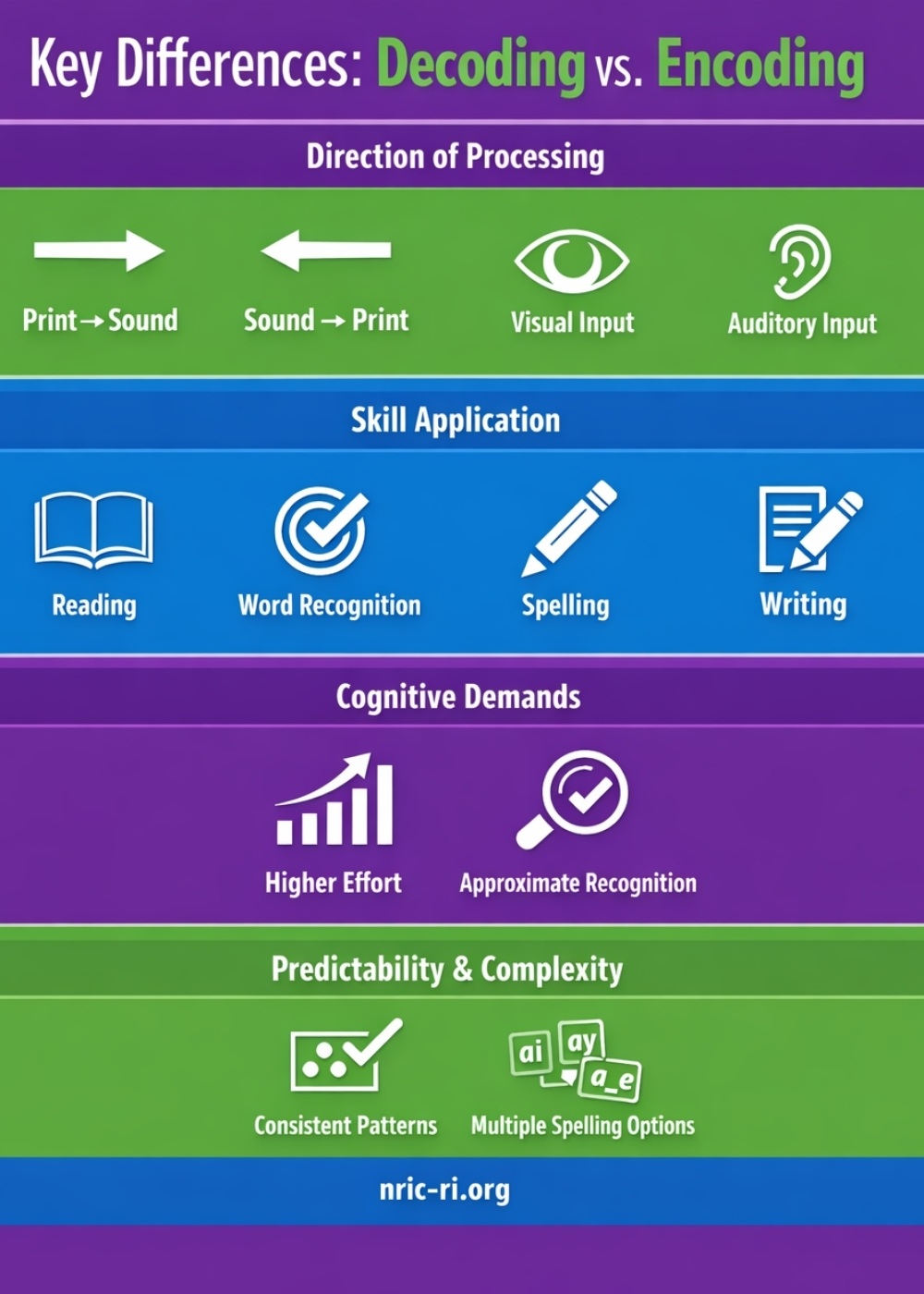
Clear distinctions between decoding and encoding help clarify how reading and writing develop. Both processes rely on the same knowledge base, yet they operate in different ways and place different demands on learners.
Direction of Processing
Processing direction marks one of the most fundamental differences. Decoding moves in one direction, while encoding moves in the opposite.
Decoding involves translating written text into spoken language. Readers look at printed symbols and convert them into sounds. Letters and letter patterns trigger recognition of spoken words stored in memory.
Encoding involves translating spoken language into written form. Writers take sounds they hear or think and represent them with letters. Sounds must be analyzed and matched with appropriate spelling patterns.
Opposite directions define these processes, yet both rely on the same sound-symbol system.
- Decoding moves from print to sound
- Encoding moves from sound to print
- Decoding begins with visual input
- Encoding begins with auditory or mental input
Skill Application

The application of each skill depends on the task at hand. Reading relies on decoding, while writing relies on encoding. Both processes draw on shared phonics knowledge, though they are used in different contexts.
Decoding is used during reading tasks. Readers apply it to recognize and pronounce words on a page. Successful decoding supports fluency and comprehension, since words can be identified quickly.
Encoding is used during spelling and writing tasks. Writers apply it to represent words correctly in written form. Accurate encoding supports clear communication and prevents confusion in written messages.
- Decoding supports silent reading, oral reading, and word recognition
- Encoding supports spelling, sentence construction, and written expression
- Both rely on knowledge of phonics and orthographic patterns
Cognitive Demands
Mental effort differs between decoding and encoding. Encoding often requires more deliberate thinking and recall, while decoding allows more flexibility.
Encoding often requires greater effort. Writers must recall correct spelling patterns and choose among multiple ways to represent a sound. Memory plays a major role, since correct letter patterns must be retrieved and applied accurately.
Decoding allows approximation. A reader may recognize a word even with partial knowledge. Context clues and familiarity with similar patterns can support recognition, even when decoding is not perfect.
Encoding requires accuracy. Correct spelling ensures clear communication. Small errors can change the meaning or make the writing difficult to interpret.
Predictability and Complexity

The structure of the English language affects how decoding and encoding develop. Predictability varies between reading and spelling, which impacts difficulty levels.
English offers more consistency in decoding than in encoding. Many letter patterns can be read in predictable ways, allowing readers to apply general rules when encountering unfamiliar words.
Spelling presents more complexity. A single sound may have several possible spellings, such as “ai,” “ay,” and “a-e.” Writers must decide which pattern fits each word, often based on position or word origin.
Greater complexity in encoding requires deeper knowledge of spelling patterns.
- Decoding relies on more consistent sound-letter relationships
- Encoding requires choosing among multiple spelling options
- Decoding supports quicker pattern recognition
- Encoding depends on detailed knowledge of orthographic rules
How Decoding and Encoding Work Together
The connection between decoding and encoding plays a central role in literacy development. Growth in one area directly supports progress in the other.
Phoneme-grapheme mapping connects sounds with letters in both processes. Readers and writers rely on this connection to process words accurately. Strong mapping skills allow smooth transitions between reading and writing tasks.
Practice in one area strengthens the other. Spelling activities improve word recognition, while reading reinforces familiarity with spelling patterns. Repeated exposure builds stronger mental representations of words.
Orthographic mapping helps store words in long-term memory. Stored words can then be retrieved quickly and automatically, reducing effort during both reading and writing.
- Writing words supports recognition during reading
- Breaking words into sounds during encoding supports sounding them out during decoding
- Repeated reading strengthens memory of correct spelling patterns
- Spelling practice reinforces accurate word recognition
Strong readers use decoding and encoding fluidly. Movement between reading and writing happens without conscious effort, allowing focus on meaning and expression.
Instructional Importance

Effective literacy instruction requires attention to both decoding and encoding. Teaching approaches that address both processes lead to stronger outcomes in reading and writing.
Structured Literacy Approach
Structured instruction provides a clear path for developing literacy skills. Explicit and systematic phonics instruction is essential for building strong foundations.
Teaching should address decoding and encoding together. Integration ensures that students apply sound-symbol knowledge in both reading and writing contexts. Multi-sensory strategies enhance learning.
Instruction becomes more effective when students actively engage with sounds and letters. Several approaches support growth in both decoding and encoding.
Dictation exercises allow students to hear words and write them, strengthening sound-symbol connections.
Word mapping and phoneme segmentation activities build sound awareness by breaking words into smaller units.
Blending and segmenting practice strengthens both reading and spelling by reinforcing how sounds combine and separate.
Word study focuses attention on spelling patterns and rules, helping students recognize and apply consistent structures.
Role of Encoding in Reading Development

Encoding plays a critical role in reading growth. Spelling practice strengthens connections between sounds and letters, leading to improved word recognition.
Encoding strengthens reading proficiency by reinforcing accurate representations of words in memory. Students who practice spelling develop stronger recognition skills during reading.
Instruction that includes encoding builds deeper word knowledge. Learners gain awareness of patterns, rules, and variations within the language system.
Supporting Struggling Learners
Students with reading difficulties often face challenges in both decoding and encoding. Weakness in one area usually affects the other.
Intervention should target key areas to support improvement.
- Phonemic awareness
- Explicit phonics instruction
- Repeated practice in reading and spelling
Encoding tasks often reveal gaps in phonics knowledge more clearly than decoding tasks. Errors in spelling can show exactly where sound-symbol connections are incomplete.
Common Misconceptions

Misconceptions about decoding and encoding can lead to incomplete instruction and limited progress. Clarifying these ideas supports more effective teaching.
The belief that decoding alone ensures reading success overlooks the importance of spelling and deeper word knowledge. Strong reading requires both recognition and accurate representation of words.
View of encoding as simple memorization ignores its reliance on patterns and rules. Spelling involves active problem-solving and application of learned structures.
The assumption that reading automatically leads to strong spelling is inaccurate. Explicit instruction in encoding remains necessary for accurate writing.
The perception of decoding and encoding as separate skills fails to recognize their interdependence.
Summary
Decoding and encoding operate as closely connected processes that strengthen one another through consistent use. Reading supports writing, and writing supports reading, creating a continuous cycle of skill development.
Growth in one area leads to improvement in the other, since both rely on shared knowledge of sounds and symbols.
Full literacy development depends on both processes working together. Strong decoding allows readers to recognize words efficiently, while strong encoding allows writers to represent ideas clearly and accurately.
Absence of balance can limit progress, since weaknesses in spelling often affect reading, and difficulties in reading can slow writing development.